

India's tourism GDP grows 7.3%, but intl. visitor spend declines despite strong domestic growth: WTTC CEO
 WTTC President & CEO, Gloria Guevara at the media roundtable in Delhi
-WTTC estimates show that India recorded a net decline of 1.9 million international visitors in 2025, even as destinations across Asia and Europe added millions of foreign arrivals.
- Domestic travel for India now accounts for 86% of total visitor spending, highlighting the country’s heavy dependence on its home market.
-WTTC recommended identifying the world's highest-spending outbound markets and designing campaigns specifically for them.
-In 2026, India's travel and tourism economy is forecast to expand 8.5%, ahead of the country's projected GDP growth of 6.4%
More insights from an exclusive conversation with the WTTC President & CEO below:
****
India's travel and tourism sector remains the third-largest tourism economy in Asia-Pacific. But a sharp fall in international visitor spending, a decline of 1.9 million international visitors in 2025 and the reforms needing attention signal that the country is failing to capture its share of the global tourism recovery, according to the World Travel & Tourism Council (WTTC).
Presenting WTTC's Economic Impact Research (EIR) 2025 and forecasts for 2026 during a media roundtable in New Delhi, WTTC President & CEO Gloria Guevara said India possesses every ingredient to become a global tourism powerhouse, but policy bottlenecks, limited air connectivity, visa challenges and weak international destination marketing are preventing it from realising that potential.
In 2025, India's travel and tourism GDP grew by 7.3%, almost matching the country's overall GDP growth of 7.5%, taking the sector's total contribution to USD 263.6 billion, or 6.6% of national GDP. The sector supported 46.2 million jobs, accounting for 10.8% of total employment, reaffirming tourism's position as one of India's largest employment generators.
While domestic travel continues to power sectoral growth, international tourism moved in the opposite direction.
India losing share of global tourism recovery
WTTC's global analysis shows that international tourism is expanding rapidly. Worldwide, international overnight arrivals increased by 82 million travellers in 2025, taking global arrivals to 1.54 billion, while international visitor spending reached USD 2.02 trillion.
Yet India somehow moved against that trend.
WTTC estimates show that India recorded a net decline of 1.9 million international visitors in 2025, even as destinations across Asia and Europe added millions of foreign arrivals. China attracted an additional 9 million international visitors, France gained 8 million, Japan 6 million, Italy and Vietnam 4 million each, while Spain, Brazil, Mexico, Egypt and South Korea each added roughly 3 million visitors.
“India is not getting its fair share. There’s a potential for achieving a double-digit growth in inbound, but only if the country moves beyond infrastructure investments and adopts a coordinated strategy focused on easier visas, seamless travel, targeted international marketing and stronger public-private collaboration,” Guevara shared with T3.

India's share of global international visitor spending slipped from 1.8% in 2024 to 1.6% in 2025, signalling that the country is gradually losing competitiveness in attracting foreign tourists despite its expanding domestic market.
Drawing comparisons with China, Guevara highlighted how targeted policy reforms have rapidly accelerated inbound tourism there. China's travel and tourism economy expanded nearly 10% in 2025, while international visitor spending rose 10.5%. According to WTTC, China's success has been driven by: Visa-free access for an expanding list of countries, transit visa liberalisation, improved international air connectivity, biometric-enabled seamless airport processing, aggressive international destination marketing, among other things.
India, she said, has made impressive investments in physical infrastructure but now needs to complement those investments with policies that improve traveller experience and ease of access.
Domestic tourism important but not enough
According to WTTC estimates shared by Guevara, international visitor spending in India declined by 8% year-on-year to USD 33 billion in 2025, while domestic visitor spending surged 10.3% to USD 203 billion.
Domestic travel for India now accounts for 86% of total visitor spending, highlighting the country’s heavy dependence on its home market.
While welcoming India's robust domestic tourism performance, Guevara cautioned against relying solely on the domestic market.
When asked, she stressed that domestic and inbound tourism should complement each other rather than compete. “Domestic tourism is extremely important and should continue growing. But it is not a zero-sum game. International visitors bring new money into the economy, and India needs both,” she said, adding that inbound tourism requires a dedicated strategy, market-specific promotion and removal of barriers for foreign travellers.
Where are India's biggest gaps in inbound?
WTTC has identified several structural barriers that continue to restrict India's inbound tourism growth.
As shared by Guevara, among the most pressing challenges are:
- Simplifying visa procedures and considering visa waivers for priority source markets
- Expanding direct international air connectivity
- Creating seamless airport experiences through technology and biometrics
- Reviving global destination marketing campaigns such as Incredible India
- Diversifying source markets instead of depending on a limited set of countries
She further remarked that while geopolitical disruptions in the Middle East have affected aviation connectivity this year, India's inbound weakness predates those developments.
Asked what India should prioritise in its international promotion strategy, Guevara recommended identifying the world's highest-spending outbound markets, including the US, China, the UK and Germany and designing campaigns specifically for them. “Look at the countries that spend the most...remove visa barriers and attract those travellers,” she told T3.
Also, rather than adopting a one-size-fits-all approach, she asserted that India should segment visitors by geography, age and travel interests. She also observed that countries such as Japan, Spain and Mexico have succeeded because governments and industry work together through unified tourism platforms and suggested the same for India.
She further urged India to build stronger positioning around wellness, gastronomy, spirituality and medical tourism, citing Thailand, Spain and Turkey as examples of countries that have successfully built destination brands around specific tourism segments. She added that India also needs to create a fully digital, seamless arrival experience through integrated tourism services and urged the centre to increase international tourism promotion funding, arguing that these measures could help India capture a larger share of global visitor spending.
India expected to rebound in 2026
Despite the setbacks recorded in 2025, WTTC expects India to stage a strong recovery this year.
International visitor spending is projected to grow by around 15% this year end, helped by the expansion of India's e-visa programme and a favourable base effect following last year's decline.
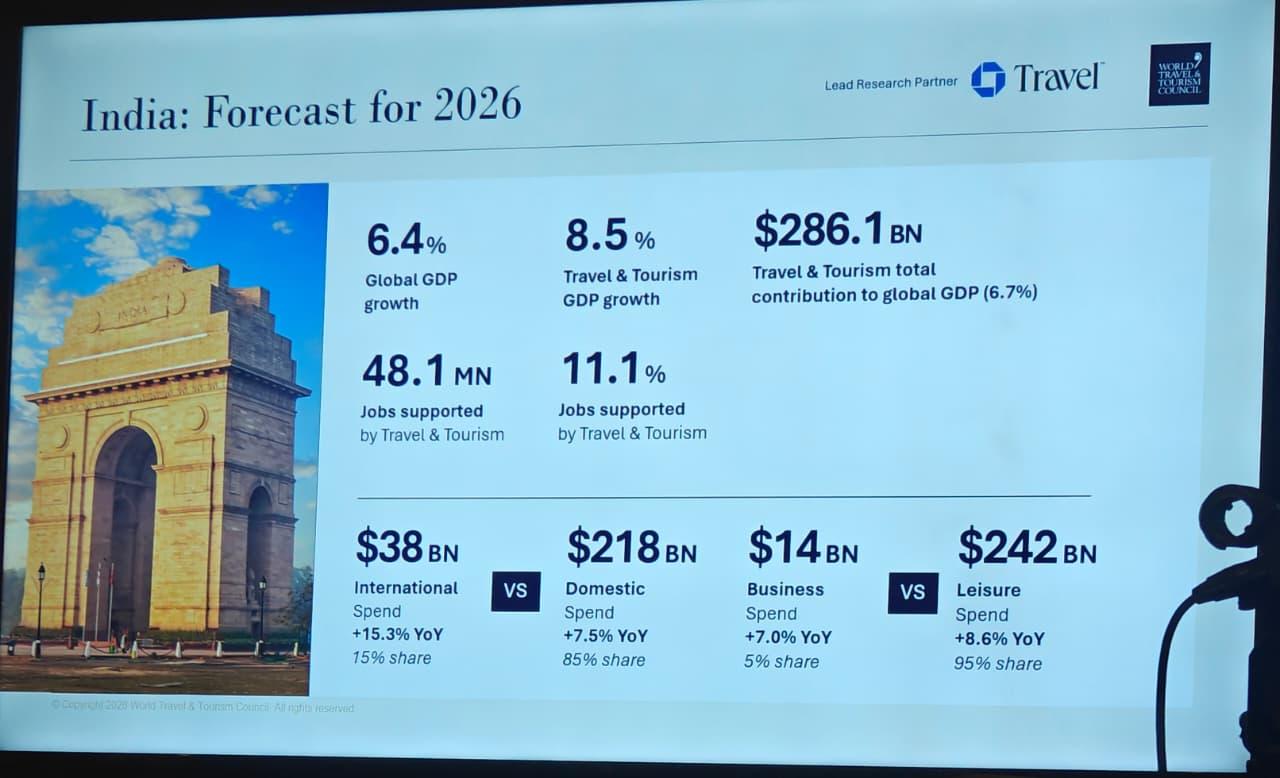
Overall, India's travel and tourism economy is forecast to expand 8.5% in 2026, comfortably ahead of the country's projected GDP growth of 6.4%, reaching USD 286.1 billion and contributing 6.7% to the national economy. Employment is expected to rise to 48.1 million jobs, accounting for 11.1% of total employment, shared Guevara.
International visitor spending is forecast to rebound by 15.3% to USD 38 billion, while domestic tourism expenditure is expected to increase 7.5% to USD 218 billion. Leisure travel is projected to reach USD 242 billion, while business travel spending is expected to grow to USD14 billion, as per the EIR.
“The assets already exist. India has culture, heritage and hospitality. The opportunity is about alignment, assigning resources and executing a common plan,” she said.
Beyond the economic outlook, WTTC CEO also presented the organisation's new seven principles for attracting tourism investment, designed to help governments create investor-friendly tourism ecosystems.
The framework calls for:
- Legal and regulatory certainty
- Single-window investment clearances
- Coordinated tourism strategies with stakeholder alignment
- Competitive fiscal, investment incentives
- Strong political leadership
- Comprehensive destination master plans
- Sustained demand growth supported by connectivity and skilled talent
According to WTTC, countries aligning with these principles will be better positioned to attract long-term private investment into tourism infrastructure and destination development.