
India chairs 1st BRICS 2026 Tourism Meet; focus on AI, sustainability, skills & seamless travel
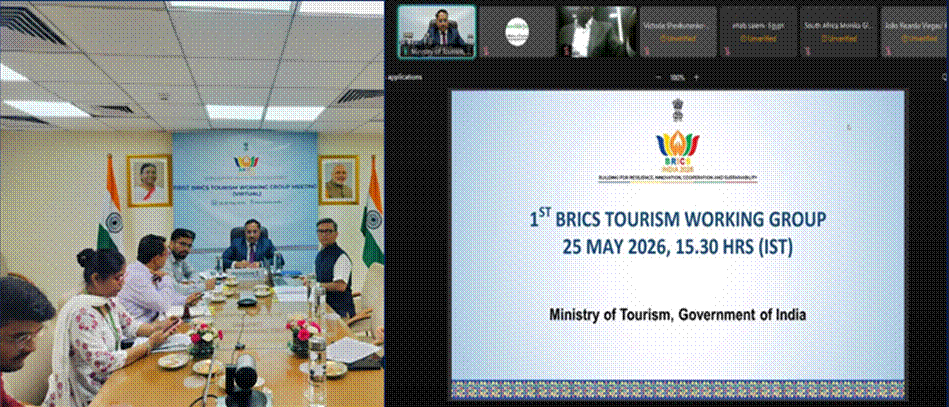 Representative Image_BRICS 1st Tourism WG Meet
Followed by this inaugural virtual meeting, the tourism cooperation process will continue with the 2nd Tourism Working Group (TWG) Meeting scheduled to be held on August 19–20, 2026 in Jaipur. This will be followed by the BRICS Tourism Ministers' Meeting (TMM) on August 21–22, 2026, also in Jaipur.
The 1st BRICS 2026 Tourism Working Group (TWG) Meeting was successfully convened in virtual mode on May 25, 2026, under India's BRICS 2026 Chairship. The meeting was chaired by Harikishore S. IAS, Joint Secretary, Ministry of Tourism, Government of India.
According to the ministry, the meeting served as an introductory and preparatory platform for advancing this year's tourism cooperation agenda under the overarching theme "Building for Resilience, Innovation, Cooperation and Sustainability." It provided BRICS member states an opportunity to present their introductory remarks and engage with India's thematic priorities for tourism cooperation.
The key thematic priorities under India’s Chairship include Artificial Intelligence and Tourism, Sustainability and Responsible Tourism, Tourism Skilling and Capacity Building, and Tourism Exchanges and Seamless Travel Facilitation.
Building on the momentum generated by this inaugural virtual meeting, the tourism cooperation process will continue with the 2nd Tourism Working Group (TWG) Meeting scheduled to be held on August 19–20, 2026 in Jaipur, Rajasthan. This will be followed by the BRICS Tourism Ministers' Meeting (TMM) on August 21–22, 2026, also in Jaipur.
Both these in-person meetings will provide a substantive platform for BRICS nations to strengthen their collaboration and advance the shared tourism agenda.
In the statement, MoT shared that with these initiatives, India looks forward to further deepening tourism partnerships among BRICS nations during the course of 2026.
Notably, BRICS brings together eleven major emerging markets and developing countries of the world: Brazil, China, Egypt, Ethiopia, India, Indonesia, Iran, Russia, Saudi Arabia, South Africa and United Arab Emirates. It serves as an ideal platform for consultation and cooperation on contemporary issues having global as well as regional significance, and issues of global political and economic governance.