

Fourth-largest economy, but 2% in global exhibitions: The gap India must close, says jwc
 Partner & Senior Consultant at jwc GmbH, Sebastian Witt
By 2027, while Asia as a whole is expected to return to 2019 levels, India is projected to exceed pre-Covid exhibition activity by more than 50%, shared Sebastian Witt, Partner & Senior Consultant at jwc GmbH. The firm also identifies India as the world's most attractive exhibition market but warns that inadequate venue infrastructure could constrain future growth.
India may have overtaken major economies to become one of the world's largest economic powers, but in the global exhibitions industry, it remains a surprisingly small player. That mismatch, according to partner & senior consultant at jwc GmbH, Sebastian Witt, represents one of the biggest untapped opportunities in the global meetings, incentives, conferences and exhibitions (MICE) sector.
Globally, the exhibition industry has been slower to recover from the pandemic than many other sectors. According to jwc insights, global exhibition activity is expected to return to pre-pandemic levels only by the end of 2027. Growth has been constrained by economic slowdown in China and geopolitical instability in regions such as the Middle East.
Speaking at an industry forum organised at HITEX Hyderabad, Witt further argued that while global exhibition markets continue to grapple with economic uncertainty, geopolitical tensions and slower post-pandemic recovery, India stands out as the industry's most attractive growth market. Yet, the country accounts for only around 2% of the global exhibition industry despite being the world's fourth-largest economy.
“India possesses all the economic fundamentals for an extremely strong and robust MICE industry,” Witt said, citing the country's expanding economy, growing middle class and favourable demographic profile.
jwc estimates that the Indian exhibition market recovered rapidly, almost reaching pre-pandemic levels by 2023 and surpassing them in 2024. Looking ahead, Witt shared the forecasts showing annual growth of approximately 8.5% in net rented exhibition space.
By 2027, while Asia as a whole is expected to return to 2019 levels, India is projected to exceed pre-Covid exhibition activity by more than 50%, shared Witt.
The numbers position India among the strongest growth markets globally at a time when mature markets in Europe face slower economic expansion and North America grapples with policy uncertainty.
Attractive market, limited infrastructure
Despite the strong outlook, jwc believes India’s exhibition ecosystem is falling behind demand.
The consultancy’s global market attractiveness model evaluates countries based on growth potential, market maturity, competition and ecosystem readiness. While India ranks highest globally on growth prospects, it scores significantly lower on ecosystem preparedness, largely because of inadequate availability of quality exhibition venues.
According to Witt, India suffers not from overcapacity, an issue seen in parts of China, but from a shortage of high-quality exhibition space.
“What we have in India is actually very much a different picture. We have an undercapacity of sufficient quality exhibition space,” he noted.
jwc’s comparative analysis of major exhibition markets found that India remains significantly below global averages in indoor exhibition space when measured against both GDP and population.
The result is a growing gap between demand and available venue capacity, potentially limiting the country's ability to host larger international exhibitions and conventions.
Forecasts
Witt’s presentation also highlighted a shift in exhibition industry priorities, with exhibitors increasingly focused on demonstrating return on investment and visitors seeking measurable return on time (ROT). Organisers are witnessing declining visitor volumes but a greater emphasis on visitor quality, while frequent exhibitors are expected to participate in fewer events and become more selective. Content-led events, specialisation, hosted buyer programmes and community-centric year-round engagement models are becoming critical success factors. AI, while not viewed as a complete game changer, is expected to enhance unique value propositions, reduce costs and improve operational efficiency, provided organisers develop robust data strategies. At the same time, attracting talent, managing omnichannel event models and measuring the carbon footprint of events are emerging as key industry challenges.
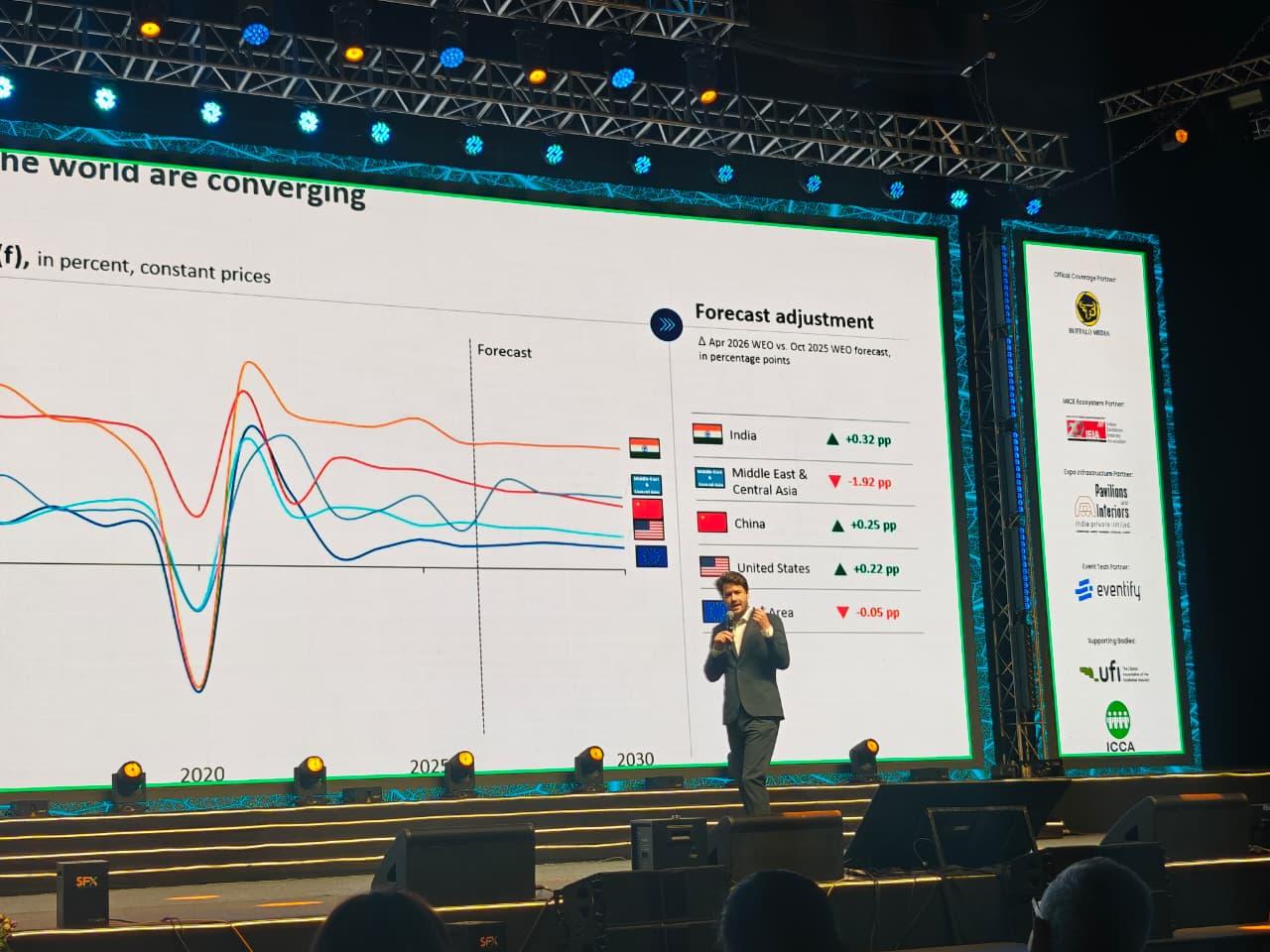
On India, Witt notes that the country is expected to remain the world's fastest-growing major economy through 2030, with the exhibition industry expanding at record pace, albeit from a relatively low base. The forecast revisions presented by jwc showed India receiving the strongest upward growth adjustment among major economies at +0.32 percentage points, compared with +0.25 percentage points for China and +0.22 percentage points for the United States, while the Middle East and Central Asia region saw a downward revision of -1.92 percentage points. Witt’s presentation suggested that if instability in the Middle East persists, India could potentially benefit as international organisers and exhibitors seek alternative growth markets. However, JWC stressed that unlocking this opportunity will require a significant increase in world-class exhibition infrastructure, improvements across the broader industry ecosystem, and greater policy recognition of exhibitions as a strategic business sector.
Witt also believes that infrastructure investment alone will not be enough if India wants to become a leading global MICE destination.
Drawing comparisons with Germany, one of the world's most developed exhibition markets, he argued that government support played a decisive role in creating globally competitive exhibition ecosystems. Germany's exhibition industry, he noted, was built through long-term public investment and recognition of exhibitions as economic development tools that support trade promotion, knowledge transfer and exports.
“If India wants to achieve a top spot in the global market, our industry needs to be treated as a priority sector by the government,” he asserted.