

ATOAI pushes for safety-first framework as India eyes top 10 global adventure tourism ranking by 2034
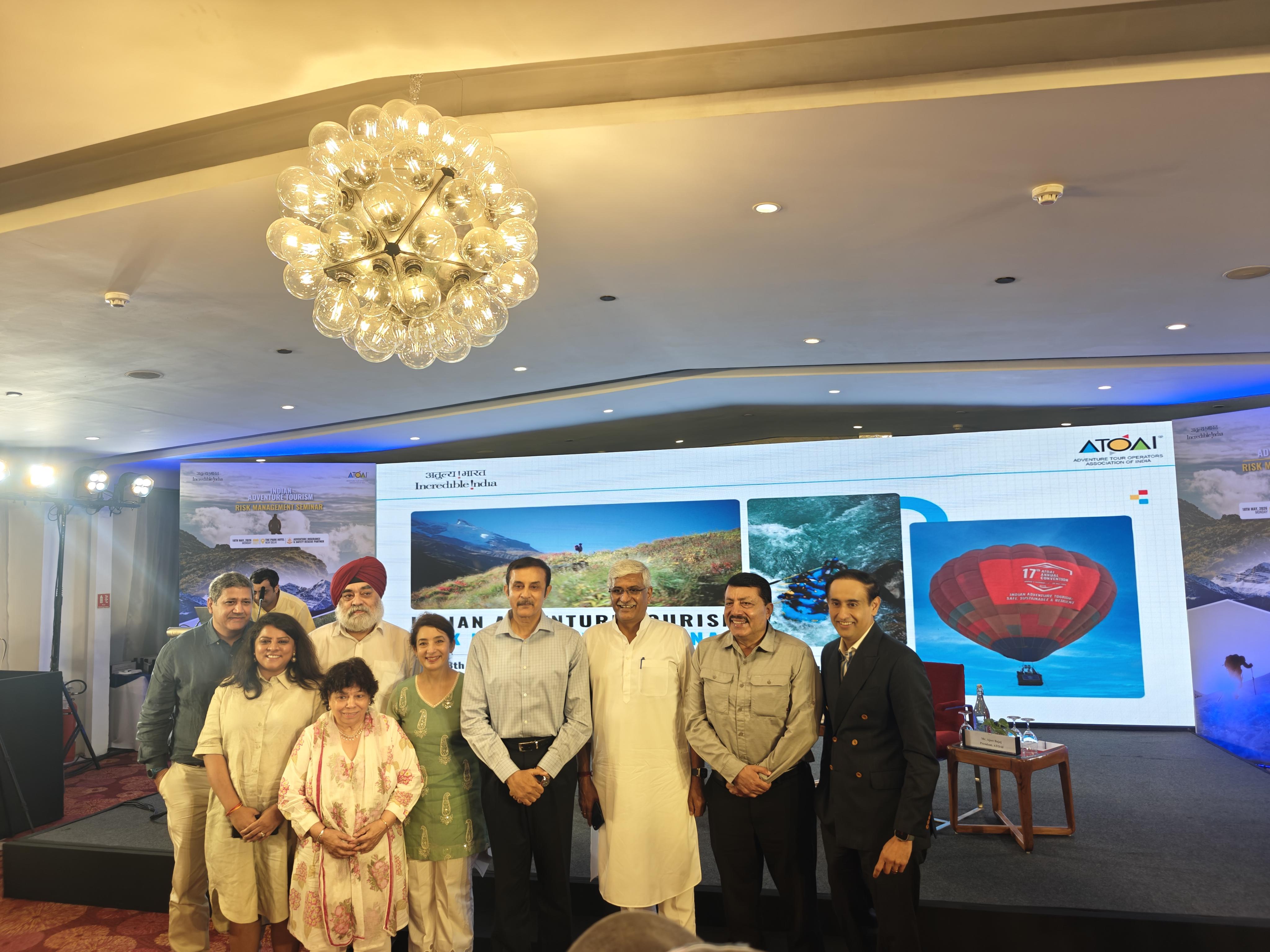 Representative Image_ATOAI Seminar MAY 18
-Standardising safety protocols for adventure tourism is the need of the hour, said Gajendra Singh Shekhawat, Union Tourism & Culture Minister.
- India’s ranking in the Adventure Tourism Development Index has improved significantly from 96 in 2020 to 38 currently but there’s miles to go before we sleep- Ajeet Bajaj, President, ATOAI.
-We need to have collective participation from policymakers, operators, rescue specialists, trainers and industry stakeholders to help evolve India as a world class adventure tourism destination, built on preparedness, professionalism and trust- Arshdeep Anand, VP, ATOAI.
(Detailed report below)
India’s adventure tourism industry is standing at a critical crossroads. What was once considered a niche segment dominated by mountaineers, trekkers, is now rapidly transforming into a mainstream experiential travel movement, powered by a booming domestic tourism economy, rising disposable incomes and a younger generation seeking immersive experiences over traditional sightseeing.
At the centre of this transition is a growing realisation within both the government and industry that the future growth of adventure tourism cannot be sustained without robust safety standards, national-level frameworks, stronger certifications and long-term infrastructure planning, especially at the time when the aim is to see India among the best 10 in adventure travel in next eight years.
Opening ATOAI’s (The Adventure Tour Operators Association of India) National Seminar on Risk Management seminar in New Delhi, association’s Vice President, Arshdeep Anand, highlighted that adventure tourism in India is no longer a niche segment, but a rapidly mainstreaming travel trend. “With growth comes responsibility — the responsibility to build systems, strengthen safety standards, and create a culture where adventure and accountability go hand in hand,” she said. Anand further reiterated the need for collective participation from policymakers, operators, rescue specialists, trainers and industry stakeholders to help evolve India as a world class adventure tourism destination, built on preparedness, professionalism and trust.
Delivering his address, Ajeet Bajaj, President, ATOAI said the perception of adventure tourism has dramatically evolved over the years. He pointed out that the global outdoor pursuits industry is now valued at USD 683 billion and growing rapidly. Despite India ranking seventh globally in terms of UNESCO natural world heritage sites, he stressed that the country still remains under-positioned in global adventure tourism. “Having experienced adventure travel across seven continents and over 50 countries, I believe India should rank among the top four globally,” he said.
He noted that India’s ranking in the Adventure Tourism Development Index has improved significantly from 96 in 2020 to 38 currently but stressed there’s more room for growth. According to Bajaj, ATOAI’s vision is to place India among the world’s top 10 adventure tourism destinations by 2034.
Bajaj further said operators globally are facing pressure to reduce costs even as travellers demand higher standards and society shows “lower tolerance for injuries and accidents.” He emphasised that only about 30% of India’s estimated 15,000 adventure tour operators are currently registered, recognised or licensed.
He further advocated for a balanced framework that ensures regulation without hampering entrepreneurship. “We need ease of doing business, speed of doing business, and peace of doing business while encouraging young adventure entrepreneurs,” he said.
Bajaj also called for stronger consumer awareness, warning that “when competition is only on cost, safety becomes the first casualty.” He urged travellers to conduct due diligence and choose certified operators.
Standardising Safety Protocols is the need of the hour
The discussion gains significance at a time when the Ministry of Tourism has recently introduced a comprehensive national framework for adventure tourism. Though tourism remains a state subject, the framework is being positioned as a foundational document that states can directly adopt and implement with minimal modification. The framework, developed in consultation with industry stakeholders and based on international best practices from countries such as Canada, New Zealand and Switzerland, is being positioned as India’s first major attempt at creating a common national baseline for adventure tourism operations.
“India’s tourism landscape is undergoing a structural behavioural shift. Travellers are increasingly moving away from monument-centric tourism towards experience-led travel. Adventure tourism, therefore, is no longer confined to niche enthusiasts but is gradually becoming a mainstream component of India’s tourism economy. The need to standardise the safety standards and the protocols — that is the need of the hour,” said Gajendra Singh Shekhawat, Union Minister of Tourism & Culture, during his on-stage conversation at the seminar.
The scale of domestic tourism is a major enabler behind this transition, according to him. “India recorded nearly 244 crore travel visits in the last year alone, highlighting the immense scale of internal movement and consumption. This strong domestic base provides India a unique advantage, especially during periods of geopolitical instability that negatively impact international travel flows.”
He also stressed that adventure tourism can create viable economic ecosystems in remote and geographically isolated regions where few other industries can operate sustainably. The Minister argued that tourism creates one of the most decentralised economic models possible, benefiting small businesses simultaneously.
The Minister also highlighted that India, alongside the United States and China, possesses one of the world’s strongest domestic tourism ecosystems, insulating the country from severe shocks during global disruptions. “Even amid geopolitical uncertainties, the expectation is that India’s tourism demand, particularly experiential and adventure-led travel, will continue to expand due to rising incomes and increasing aspiration among young Indians,” he quoted confidently.
Protecting consumer confidence, prioritising safety
Despite the sector’s rapid growth, the attendees also acknowledged that India’s adventure tourism ecosystem remains largely fragmented and inconsistently regulated. One of the biggest concerns raised was that consumers often prioritise cheaper operators over certified and experienced ones, creating dangerous compromises on safety standards. This makes regulation, trained manpower, equipment standards and rescue preparedness non-negotiable components of sectoral growth.
The minister also acknowledged a worrying statistic; only around 35% of adventure tour operators in India currently possess licences or formal registrations. This lack of standardisation has created major trust deficits, especially when accidents occur. He warned that even a single incident can significantly damage consumer confidence across the sector.
To address this, a mandatory registration systems, standard operating procedures, periodic audits, guide certifications and stronger consumer awareness campaigns will encourage travellers to choose only recognised operators, he added.
Notably, the Adventure Tour Operators Association of India (ATOAI), which helped shape the newly launched framework, emphasised that operators are already conducting specialised training programmes covering wilderness first aid, CPR, rescue operations, technical competencies and communication skills in partnership with the Ministry of Tourism and several state governments.
Creation of an inter-ministerial national safety management group
Another important point during the discussion centred around whether India requires a national-level certification authority similar to global models like PADI for scuba diving. Bajaj added saying that while states may implement regulations independently, adventure tourism needs nationally recognised certification systems to assess guides, instructors and operators.
In response, he also confirmed that discussions are already underway with the Bureau of Indian Standards (BIS) to develop formal standards for adventure tourism. Additionally, India has adopted ISO 21101, the international Adventure Tourism Safety Management Systems standard, marking a major step towards global alignment.
He also proposed the creation of an inter-ministerial national safety management group to oversee standardisation efforts across states and tourism activities.
Infrastructure, a big bottleneck
While optimism around the sector’s growth remained high, infrastructure gaps emerged as one of the sharpest concerns. The moderator, Rahul Kanwal, Editor-in-chief of NDTV pointed out that many destinations still suffer from inconsistent government attention, poor ski infrastructure, inadequate accessibility and lack of long-term planning.
Answering this, Shekhawat said that the government linked its broader tourism infrastructure strategy to the Prime Minister’s vision of developing 50 new iconic destinations of global standards. “Interestingly, most states proposing destinations under this initiative have incorporated adventure tourism components into their plans. The need of the hour was to decongest of the existing tourist destinations.”
He added that as demand grows, supporting infrastructure such as transport systems, accommodation, rescue facilities and adventure hubs will naturally attract greater investment. Simultaneously, government schemes are expected to support states in developing tourism infrastructure in emerging destinations.
Looking ahead, he shared that the sector could emerge as one of India’s largest tourism growth engines by 2047. “When we reach 10% tourism contribution to GDP, naturally adventure tourism will be the largest component of that,” he said, adding that tourism could eventually become India’s biggest employment generator after agriculture.
However, the success of this transformation will ultimately depend on how effectively states adopt these frameworks, how rigorously operators comply with safety protocols, and whether India can create credible national certification systems that inspire consumer trust globally.
The Adventure Tour Operators Association of India organised a one-day seminar on May 18, 2026, at The Park Hotel, New Delhi, bringing together policymakers, global experts, expedition leaders and adventure tourism stakeholders to discuss safety, sustainability and global best practices in the sector. Sessions, followed by open house discussions, focused on global SOPs and risk mitigation systems, Indian best practices across land, air and water-based adventure activities, safety protocols, incident response mechanisms and international learnings relevant to India’s adventure tourism ecosystem.
The seminar also featured detailed discussions on the Adventure Tourism Safety Framework, Safety Management Systems & ISO 21101, regulation of adventure tourism, guide skilling and certification, equipment inspection and maintenance, and the role of guidelines in risk management. Global experts including Neil Davidson (PADI), Gustavo Timo (ATTA), Gerry Moffatt, Dr. Clare Dallat, Col RS Jamwal and others shared insights during the sessions.
The event concluded with a special address on “The Way Forward for Indian Adventure Tourism” by Suman Billa, IAS, Additional Secretary & Director General, Ministry of Tourism, Government of India, followed by networking dinner.