

83% Indian industry respondents expect their business activity to grow by over 5% in 2026: UFI
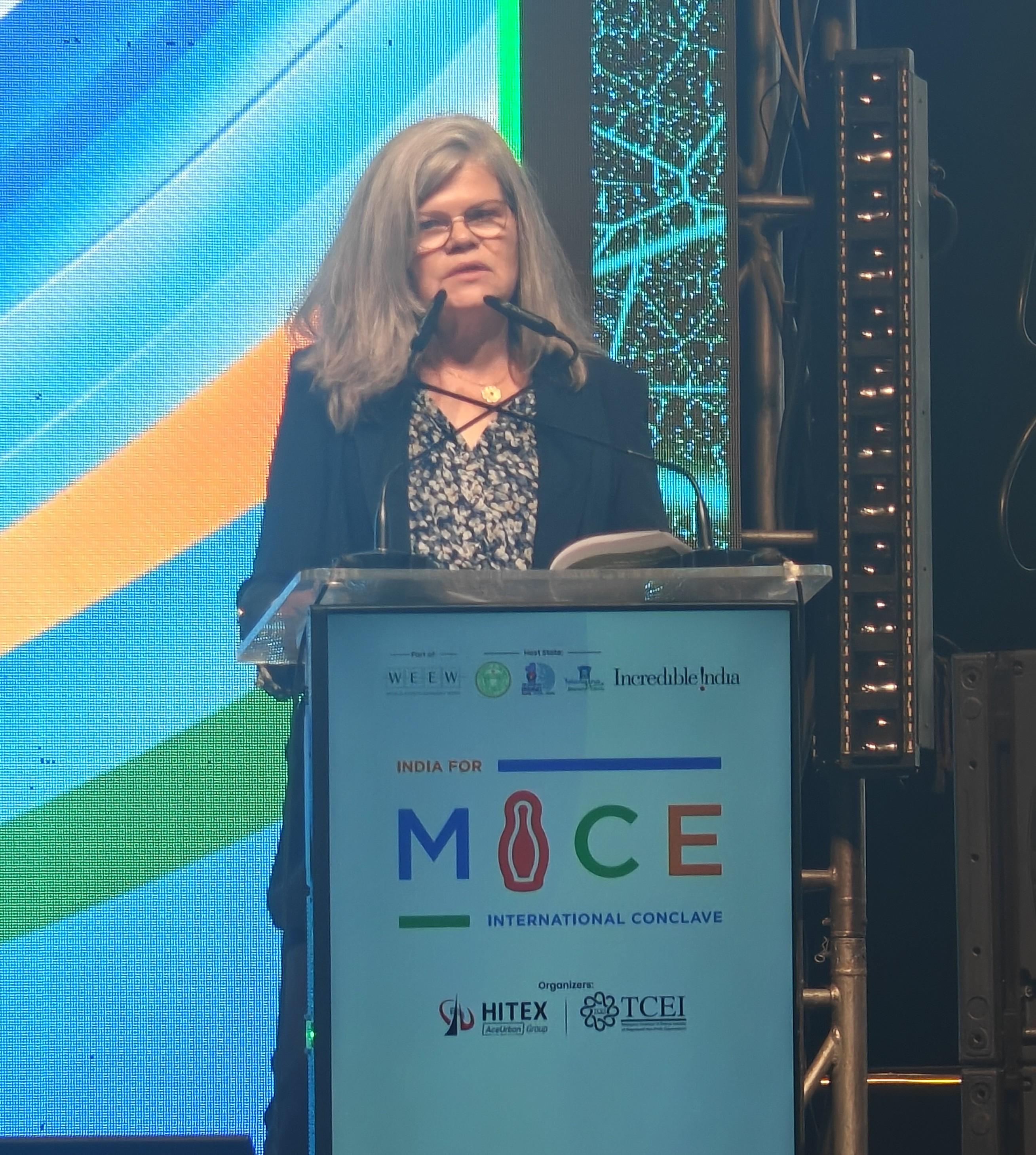 Adeline Vancauwelaert, Chief Operating Officer, UFI
UFI research, conducted with jwc, shows that Asia-Pacific remains the world's largest exhibition region by venue capacity, while India contributes only around 4% of that regional inventory. The country's 19 large-scale exhibition venues together offer total venue space of 639,000 sqm, highlighting substantial room for growth as demand increases, shared UFI’s Adeline Vancauwelaert, Chief Operating Officer.
India may account for just 4% of Asia-Pacific's exhibition venue capacity today, but it is indeed emerging as one of the most optimistic and strategically important markets for the global exhibitions industry. According to UFI, the Global Association of the Exhibition Industry, India is now its fifth-largest member country, and industry leaders are betting that the country's exhibition growth story is only just beginning.
Presenting UFI's latest global outlook at the India for MICE Conference in Hyderabad, Adeline Vancauwelaert, Chief Operating Officer, highlighted a striking contradiction. While India remains underrepresented in exhibition infrastructure, with only 19 venues larger than 5,000 sqm and a total indoor exhibition capacity of 639,000 sqm—it is among the world's most confident markets. UFI insights show 83% of Indian industry stakeholders expect their business activity to grow by more than 5% in 2026, significantly ahead of the global average, as shared by Vancauwelaert.
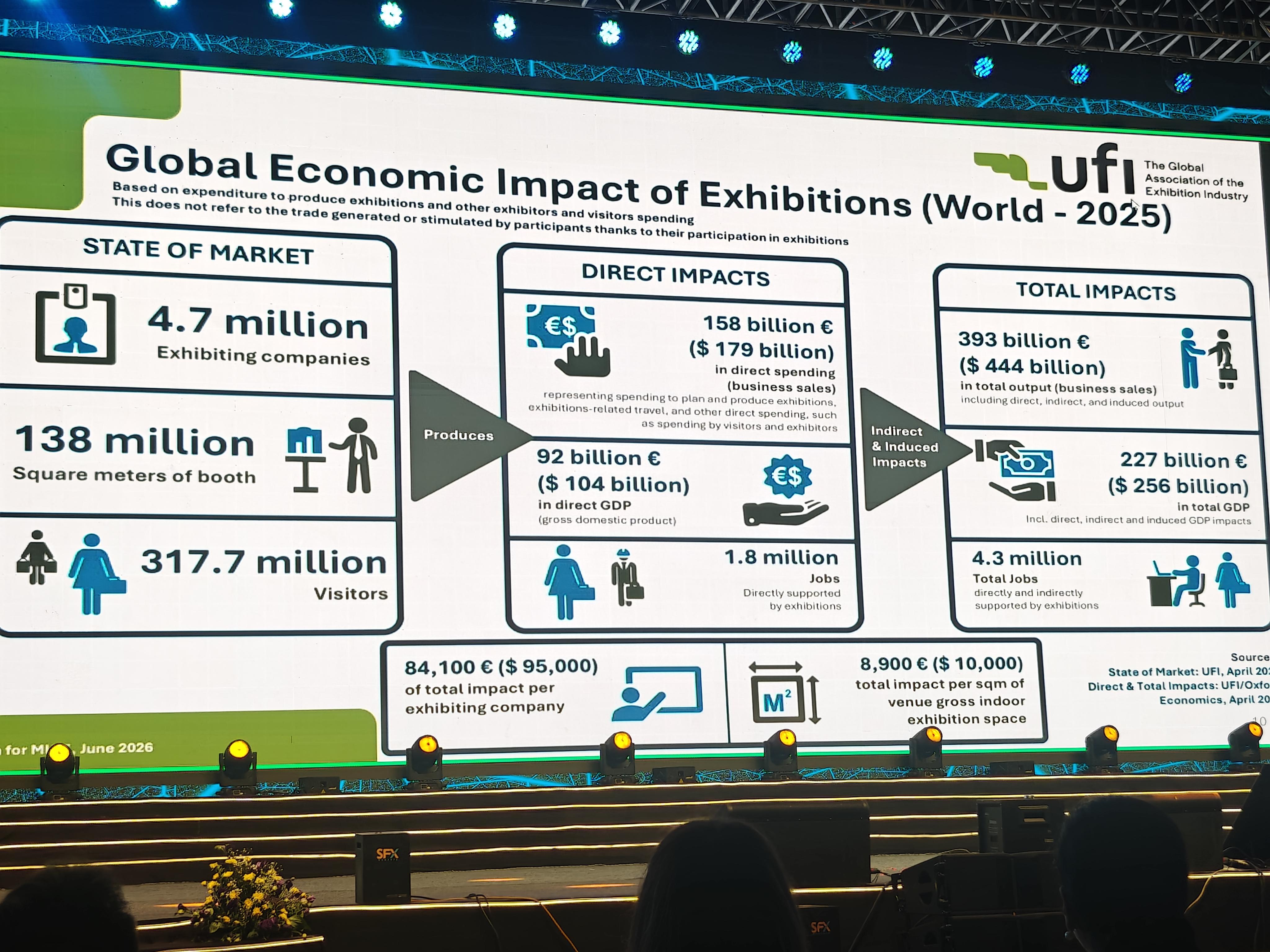
UFI’s 2025 Global Economic Impact of Exhibitions report shows the exhibition industry continues to be a significant contributor to the global economy. The exhibitions industry hosts 4.7 million exhibiting companies, attracts 317.7 million visitors and generates a total economic impact of EUR 227 billion in GDP globally while supporting 4.3 million jobs. The industry generates EUR 158 billion (USD 179 billion) in direct spending through exhibition planning, participation, travel and related activities, contributing EUR 92 billion (USD 104 billion) directly to global GDP and supporting 1.8 million jobs.
Yet India's share of that market remains relatively modest.
UFI's research, conducted with jwc, shows that Asia-Pacific remains the world's largest exhibition region by venue capacity, while India contributes only around 4% of that regional inventory. The country's 19 large-scale exhibition venues together offer total venue space of 639,000 sqm, highlighting substantial room for growth as demand grows, shared Vancauwelaert.
The emergence of large-scale infrastructure such as Bharat Mandapam in New Delhi, alongside new convention and exhibition centres across the country, is expected to strengthen India's ability to compete for international exhibitions and large-scale business events, she added.
Growth outlook outpaces the world
While the global exhibition industry has nearly returned to pre-pandemic levels, with 138 million sqm of exhibition space rented worldwide, India is moving faster than most markets.
According to UFI's latest Global Barometer, 44% of industry respondents worldwide expect activity to increase by more than 5% in 2026. In India, that figure jumps to 83%.
“The confidence reflects broader economic fundamentals. A growing economy, expanding middle class, rising domestic consumption and increasing government investment in infrastructure are creating favourable conditions for exhibitions, conferences and trade events,” said Vancauwelaert.
However, she also cautioned that geopolitical developments, particularly ongoing tensions in the Middle East, could temper global growth expectations. Future editions of the association's barometer, expected soon, are likely to reflect concerns around participation levels, event postponements and broader economic uncertainty.
India pushing for more experiential events
Indian organisers are also showing greater appetite for innovation in event formats.
UFI's findings reveal that 45% of Indian respondents believe exhibition formats need significant evolution. The focus is increasingly shifting beyond square metres sold towards creating engaging experiences through networking, local cultural elements, social events and content-led discussions.
This trend aligns closely with India's ambition to position itself as a leading global MICE destination, where events are not merely trade platforms but catalysts for business, destination promotion and economic development.
5 trends expected to shape the industry in 2026; human connection leads
Drawing from its global research, the association identified five trends expected to shape the industry in 2026: human connection and trust, uncertainty as the new normal, experience-led event design, AI and data-driven decision making, and sustainability.
The strongest trend, according to UFI, is the enduring value of face-to-face engagement. According to UFI's Explori research, exhibitor satisfaction, event importance and likelihood of returning remain above pre-pandemic levels. The strongest gains have been recorded in customer relationship building, product launches and market expansion: areas where physical interaction continues to outperform digital alternatives.
On geopolitical related uncertainties, Vancauwelaert stated that rather than treating disruption as an occasional challenge, organisers are now building resilience into everyday operations. Geopolitical tensions, supply chain disruptions and economic volatility are forcing exhibition businesses to adopt more flexible planning models and stronger scenario-based strategies. For Indian respondents, geopolitical risks are expected to become the single biggest medium-term business concern, surpassing even domestic market conditions, she added.
Also, Artificial intelligence is steadily becoming embedded within exhibition operations. While most companies are still in the testing phase, adoption is accelerating across process optimisation, customer experience enhancement and revenue generation.
Vancauwelaert shared that globally, 68% of companies are already using standard AI tools in at least some business functions, compared with 54% in India. UFI insights add that AI's biggest value will lie in improving personalisation, extending event lifecycles and helping organisers demonstrate stronger return on investment.
Environmental performance is also increasingly becoming a deciding factor in participation and investment decisions.
Vancauwelaert highlighted the Net Zero Carbon Events Initiative, launched at COP26, which now includes more than 700 organisations from 73 countries, including 10 Indian organisations. The initiative aims to create common measurement framework, encourage collaboration across the event supply chain and accelerate the industry's transition towards net-zero emissions.