

Booking.com report finds 47% believing AI is efficient at finding niche LGBTQ+ tourist friendly spots
 Booking.com report _ Representative Image
Only 31% of Indian LGBTQ+ travellers say they are ‘out’ when they travel. 49% of Indian LGBTQ+ travellers feel safer asking AI sensitive questions about the local LGBTQ+ scene than asking a human.
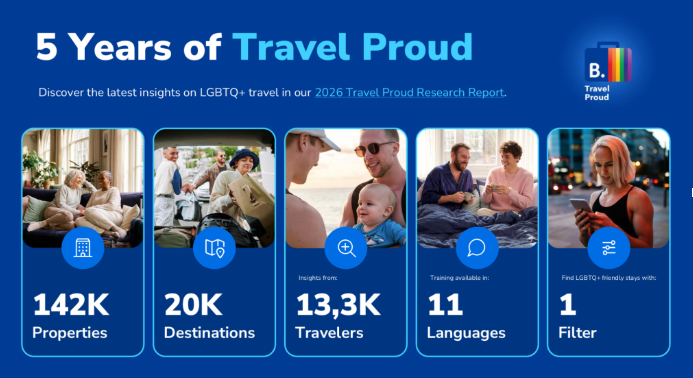
Booking.com released its latest Travel Proud Research Report, the company’s most expansive and cross-cutting survey to date, focused exclusively on the attitudes, actions and perceptions of LGBTQ+ travellers. With insights from 13,300 LGBTQ+ travellers across 19 countries, the research highlights the broad range of experiences across different parts of the community.
A striking finding in this year’s report: the LGBTQ+ travellers who report the fewest negative experiences and who appear to be the most confident - are those who identify as ‘not out’. Travellers who are ‘not out’ are the least likely to have had a negative experience related to their sexuality on a trip in the last twelve months. 34% of all Indian LGBTQ+ travellers who are not out, compared to 62% of all LGBTQ+ travellers globally who are out, this number rises to 73% for Indian LGBTQ+ travellers who identify as trans. They are also the only group where a majority didn’t report feeling anxious when travelling 48% of APAC travellers compared to 15% Indian travellers. It’s a stark reminder that the “safest” LGBTQ+ travellers are often the ones who are most effectively able to hide parts of who they are.
The decision to conceal parts of their identity, whether by choice or out of necessity, is sadly a reality shared by the majority of the Indian LGBTQ+ travellers surveyed. Only 31% of Indian respondents are out when travelling, compared to the 60% who are out to close friends. The findings also reveal the compromises many continue to navigate when travelling, with 46% willing to hide their identity in exchange for experiencing a bucket-list destination, highlighting that, for many, deciding between exploring the world and being fully themselves still involves profound trade-offs.
Further to that, 66% of Indian LGBTQ+ travellers also say that they are taking more precautions than they were a few years ago; actions like sharing live locations with trusted contacts to manage anxiety (34%), deleting dating apps before border crossings (28%), using VPNs to disguise activity or access blocked sites (32%) and carrying burner phones (34%) are common. More than half (56%) of Indian LGBTQ+ travellers constantly scan their surroundings before showing affection to their partner in public.
The data also highlights the challenges faced by trans travellers. They are the only group where the percentage who have become more anxious about travel outpaces their peers who’ve become more relaxed in recent years. 45% APAC travellers feel more anxious in the last few years compared to 38% of Indian trans travellers. And while for most demographic groups, being ‘out in public late at night or after dark’ is the most frequently cited anxiety moment, this holds true for 29% of Indian trans travellers.
Despite these trends, encouragingly Indian LGBTQ+ travellers report far more positive experiences than negative ones globally, with 94% sharing at least one positive experience specific to their gender or sexual identity when traveling in the last year. These range from: staff using correct pronouns (45%), signs of inclusivity at a property such as pride flags (42%) or gender-neutral bathrooms (42%) and LGBTQ+ staff members (44%). And 74% of Indian LGBTQ+ travellers believe that acceptance has improved in the last few years.
Interestingly, the same digital tools that Indian LGBTQ+ travellers are taking precautions with, are on the flip side, increasingly seen as ways to search for impartial information, connect with members of the community in destinations and find reassurance about a hotel or attraction. Almost 9 out of 10 (88%) of Indian LGBTQ+ travellers used AI to plan a trip in the last year, with 48% trusting AI to provide objective, non-judgmental travel advice regarding their identity. While 47% believe AI is efficient at finding niche LGBTQ+ friendly spots which are hard to find via standard search, 49% feel safer asking AI sensitive questions about the local LGBTQ+ scene than asking a human and 35% say that they would find an inclusion or ‘LGBTQ+ friendly’ filter useful when booking travel online.
Santosh Kumar, Regional Head, South Asia at Booking.com, said, “This year’s research shows why our Travel Proud program continues to be as important as ever. We’re encouraged by how the program has grown in the five years since it launched in 2021 and how enthusiastically it has been embraced by so many of our partners around the world. Training is now available in 11 languages and has been completed by more than 142,000 properties, allowing travellers to filter for LGBTQ+ friendly properties in over 20,000 cities and destinations across the globe. Despite the challenges, and the increased precautions LGBTQ+ travellers are taking in order to feel safe, we are inspired by the 69% of Indian LGBTQ+ travellers who prioritise trips where they can be 100% authentically themselves; and who continue to fiercely and authentically Travel Proud.”