
India needs distributed demand, not more domestic tourism: Tourism Secretary
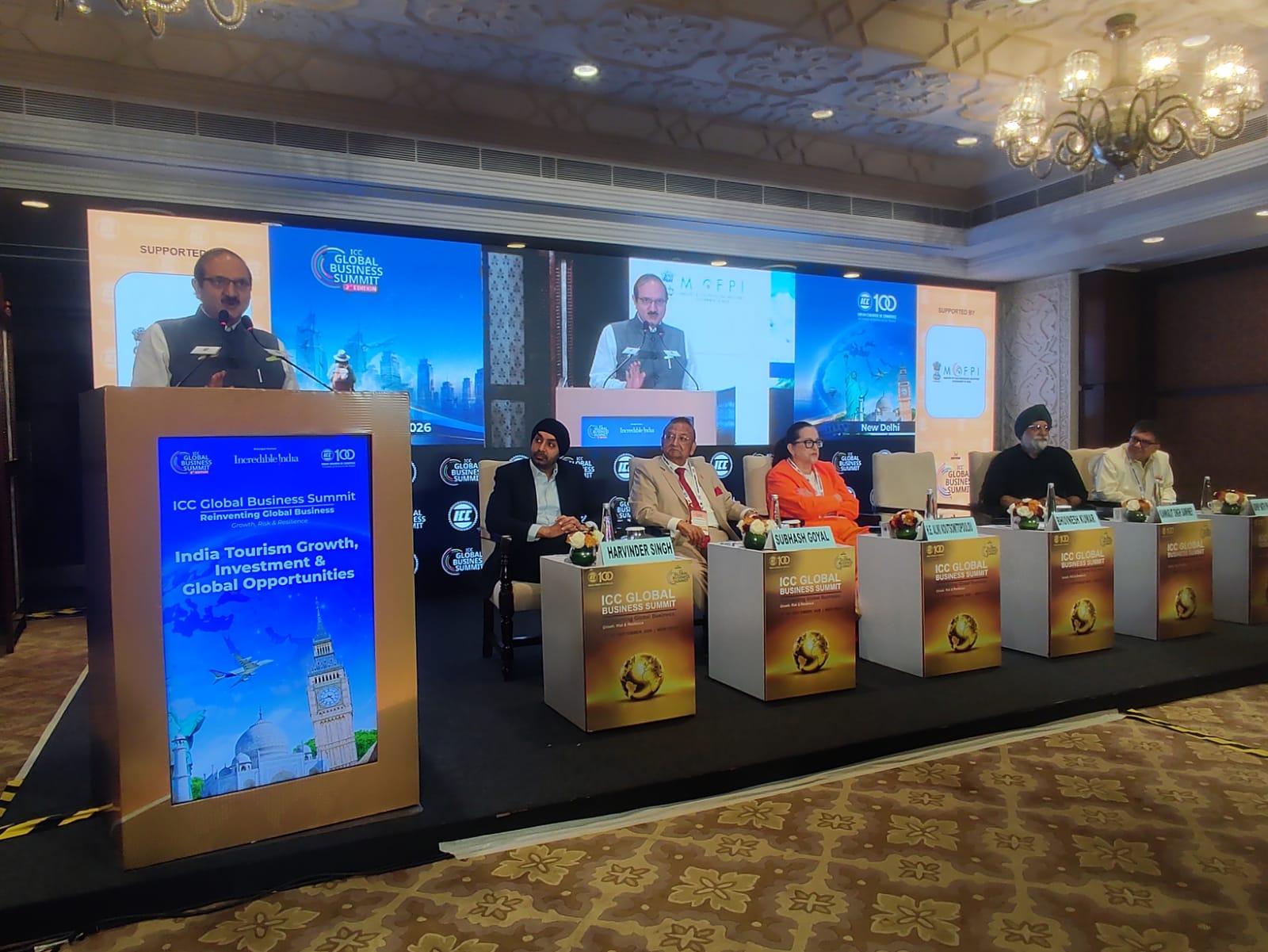 Tourism Session Address by Chief Guest Shri Bhunvesh Kumar, IAS, Secretary, Ministry of Tourism, Government of India
Listing the recent visa reforms Kumar highlighted that about 23,000 products and experiences identified for ONDC, visa categories cut from 22 to nine, and e-visa now covers 171 countries.
Addressing a session on India Tourism Growth, Investment and Global Opportunities at 2nd ICC Global Business Summit 2026, Bhuvnesh Kumar, IAS, Secretary, Ministry of Tourism, Government of India, outlined key strategic shifts for India’s travel sector.
He highlighted that India, which was net positive on travel foreign exchange till about 2021, is now net negative, with Indians spending more abroad than foreign visitors spend at home. “Till about 2021, we used to be net foreign exchange positive on travel, and now we are net foreign exchange negative. That means Indians are spending more abroad than the foreigners coming and spending in India. The industry needs to be ready for that and offer tourism experiences which are at par with the best in the world,” said Kumar.
Despite domestic visits reaching 429 crore last year, the Ministry is steering away from volume-centric goals. “We don’t really need more domestic tourism. We need distributed demand,” Kumar noted, introducing the Dekho Apna Desh 2.0 initiative aimed at channelling flow from overcrowded hubs to emerging destinations like Turtuk, Gurez, Doodhpatri, and Varkala. Hospitality expansion reflects this decentralisation, with major chains rapidly pipeline-building across Tier 2 and Tier 3 markets.
Listing recent visa reforms, Kumar mentioned visa categories have been brought down from 22 to 9, the medical value visa now runs for one year instead of 60 days, and e-visa is available to 171 countries. On digital plans, the Ministry piloted ONDC in Varanasi with about 180 tourism products, has since identified about 23,000 products and experiences across the country, and is working towards a single customised travel pass.
The shift towards experience-led, digitally connected travel was echoed from the aviation side. Harvinder Singh, Director, India Knowledge Center and Head, Middle East and India, United Airlines, said, “We are moving from destination to experience, and I am talking about the end-to-end experience. It is not only about the Taj Mahal or Jaipur or Agra today.” He also warned that emerging destinations may not sell as they should unless they are visible online. “The real estate on the digital platform is equally important as it is on the ground,” he said.
Aliki Koutsomitopoulou, Ambassador of Greece to India, cited India’s Ministry of Tourism data that the number of Indian nationals travelling to Greece rose from 21,630 in 2022 to 29,523 in 2023 and 37,150 in 2024, 72% increase in Indian travel to Greece from 2022 to 2024. “The direct flights did not create Indian interest in Greece. The demand was already there. Connectivity can now unlock it,” she said. Direct scheduled flights between the two countries began in January 2026. Over 400 Indian travel professionals are set to attend the 40th TAFI Convention in Rhodes this October to develop B2B ties and product inventory.