

India tops General Travel New Zealand's source markets; MICE drives 40% of business
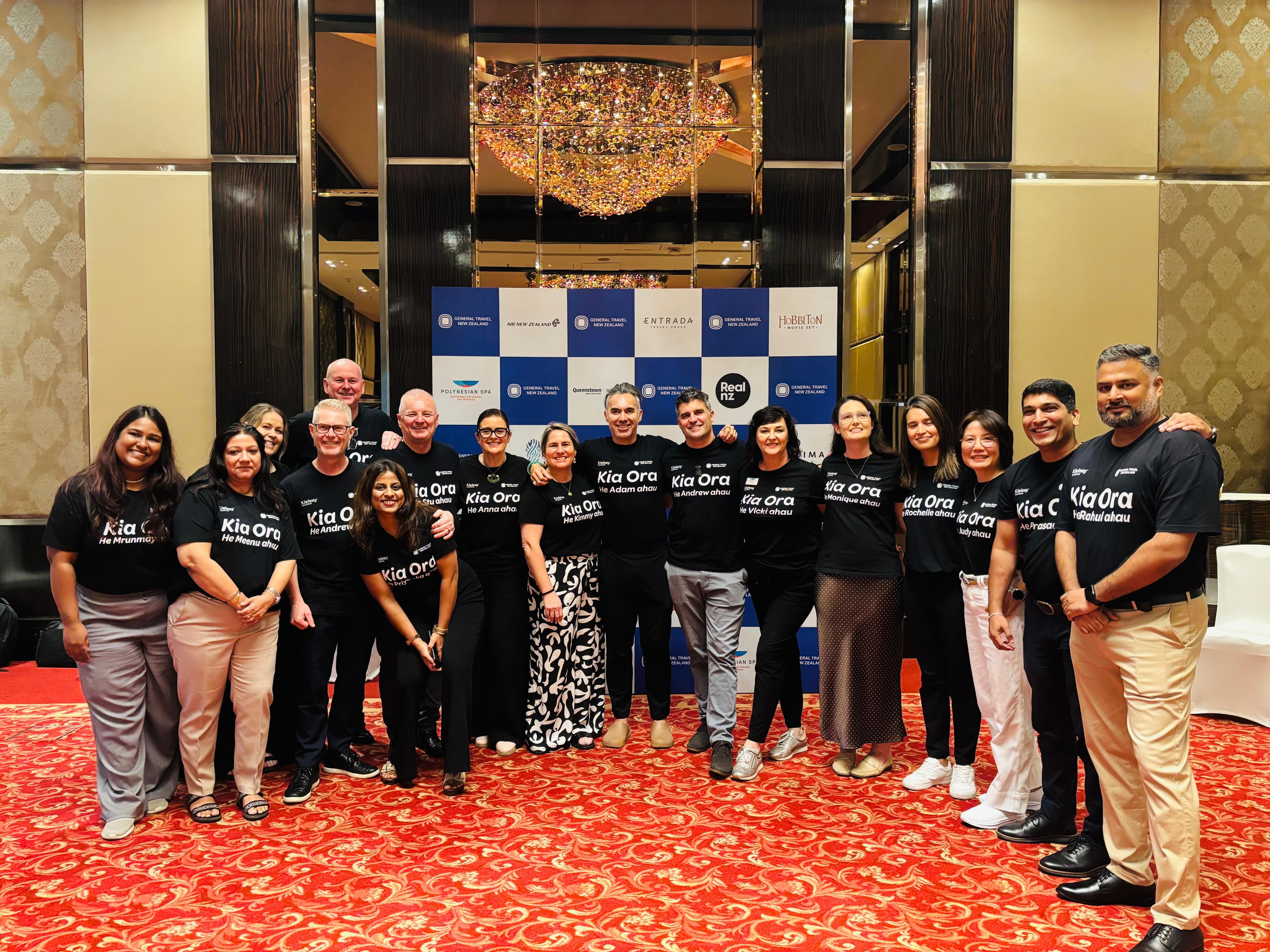 Roadshow Group Picture

Black estimated that MICE contribute around 30-40% of the company's business, with another 30-40% generated by group travel, including series departures, ad hoc groups and special interest groups. FITs, honeymooners and family travellers account for the remaining 20-30%.
India has emerged as the largest single-country source market for General Travel New Zealand, with the DMC witnessing robust demand across leisure, MICE and group travel segments. While air connectivity remains the biggest constraint to future growth, the company is optimistic about sustaining momentum, particularly if direct flights between India and New Zealand are introduced.
Speaking exclusively to T3 during the company's India roadshow in Mumbai, Anna Black, Executive Director, General Travel New Zealand, joined by its India representative Global Destinations and a 12-member partner delegation, said the primary objective of the annual multi-city initiative is to equip Indian travel advisors with the knowledge and confidence to sell New Zealand more effectively.
India remains the biggest market
Highlighting India's strategic importance, Black said the country today contributes more business than any other individual source market for the company.
"India is hugely important to New Zealand and to our business. We are probably the largest DMC handling the India market for New Zealand, and it continues to grow. We value that growth enormously and certainly don't take it for granted. At the moment, India is our biggest single-country market," she noted.
Besides India, General Travel New Zealand also serves travellers from North America, the UK, parts of Western Europe and Southeast Asia. While the combined Southeast Asian markets form a close second, India continues to lead on an individual country basis.
6-city strategy to balance mature & emerging markets
Explaining the rationale behind this year's six-city India roadshow, Black said the company deliberately rotates destinations each year to maximise market outreach.
"We can't visit every city every year, so we mix it up. Ahmedabad returned this year because Gujarat is a very important market for New Zealand. Kolkata remains a regular stop, Chandigarh has shown promise as an emerging market, while Indore is a completely new addition this year," she said.
The roadshow also follows a balanced strategy of covering established, mid-tier and emerging markets. Alongside traditional metro markets such as Mumbai, Delhi, Kolkata, Chennai, Bengaluru, Hyderabad and Ahmedabad, the company is actively cultivating demand from cities including Jaipur, Indore, Chandigarh and Surat.
"We're now seeing real traction from the eastern market as well, particularly Kolkata, where a significant amount of incentive business originates," she added.

Indian travellers spending longer in New Zealand
According to Black, travel behaviour from India has evolved significantly since the pandemic. She observed that travellers are increasingly choosing New Zealand as a standalone destination. “Since COVID, we are seeing a shift towards mono-destination travel. Earlier, travellers would often combine Australia and New Zealand in one itinerary, but increasingly they are choosing to focus solely on New Zealand. FIT travellers, in particular, are now staying for 13 to 14 days instead of the earlier 10 to 12 days," she said.
Black attributed this to travellers recognising the destination as a once-in-a-lifetime experience and wanting to explore it more comprehensively.
She also noted a gradual shift in traveller preferences beyond traditional sightseeing. "Indian travellers have always packed their itineraries with activities. Now we're seeing growing interest in short walks, hiking experiences and culinary offerings. We're also seeing increasing numbers of families and honeymooners travelling to New Zealand," she said.
The honeymoon segment continues to peak between November and March, which is the most expensive time of the year, while families largely travel during April, May and June, benefiting from pleasant weather and comparatively lower visitor volumes.
India rebounded faster than any source market
Black recalled that New Zealand's delayed reopening after the pandemic initially posed challenges, but demand from India exceeded all expectations once borders reopened.
"When New Zealand reopened, India came back with a boom. While Australia's, China's and the United States' recovery was tracking at around 60 to 80% of pre-COVID levels, India immediately reached around 130% of pre-pandemic numbers, and we really got bombarded when the borders opened. We weren't expecting that level of demand when the borders reopened," she said.
Technology & direct flights key to next growth phase
Looking ahead, General Travel New Zealand is investing in technology to improve operational efficiency while retaining its personalised service model.
"We're implementing new technology that will allow us to process bookings much faster while maintaining the high level of personalised service and destination expertise our clients value. It will help us automate routine tasks so our team can focus on delivering better customer experiences," Black said.
Flights remain biggest challenge
While visa processing has improved considerably, Black said accessibility continues to be the industry's primary concern. She believes future growth will largely depend on improved air connectivity.
"The next five years are about growth, and a direct airline service would be a real game changer. At the moment, airline capacity is restricting the pace at which the market can grow," she remarked.
She acknowledged the efforts made in streamlining visa approvals but stressed that flight availability and airfare remain the biggest barriers.
"Flights and visas have always been the biggest issues. Visa processing has improved significantly, but flight availability and, more importantly, airfare are the biggest challenges," she said.
New Zealand is aspirational, not luxury
Black also sought to clarify the perception of New Zealand as a premium destination, emphasising that premium should not be confused with luxury.
"We have to be careful with the word 'premium' because people often interpret it as luxury. That's not what we mean. New Zealand offers excellent three-star and three-and-a-half-star accommodation and wonderful experiences. It's a premium destination because it's a long-haul, aspirational, bucket-list holiday, not because every experience is luxurious," she explained.
She added that accommodation costs in New Zealand compare favourably with many global cities, but travellers need realistic expectations about the total cost of a long-haul holiday.
"Once visitors arrive, the experience consistently exceeds expectations. The challenge is usually managing expectations before they travel, particularly regarding the overall cost of the trip," she said.
MICE: strongest-performing segment
Among all business segments, MICE is currently delivering the strongest performance for General Travel New Zealand.
Black estimated that MICE contribute around 30-40% of the company's business, with another 30-40% generated by group travel, including series departures, ad hoc groups and special interest groups. FITs, honeymooners and family travellers account for the remaining 20-30%.
"There's been a strong resurgence in MICE since COVID. We initially thought demand might soften this year, but instead it has continued to grow. New Zealand is incredibly popular for MICE right now, and it remains our strongest-performing segment," she concluded.