
IEIA Open Seminar 2026 pitches for collaboration, skilling, tech to build seamless exhibition ecosystem
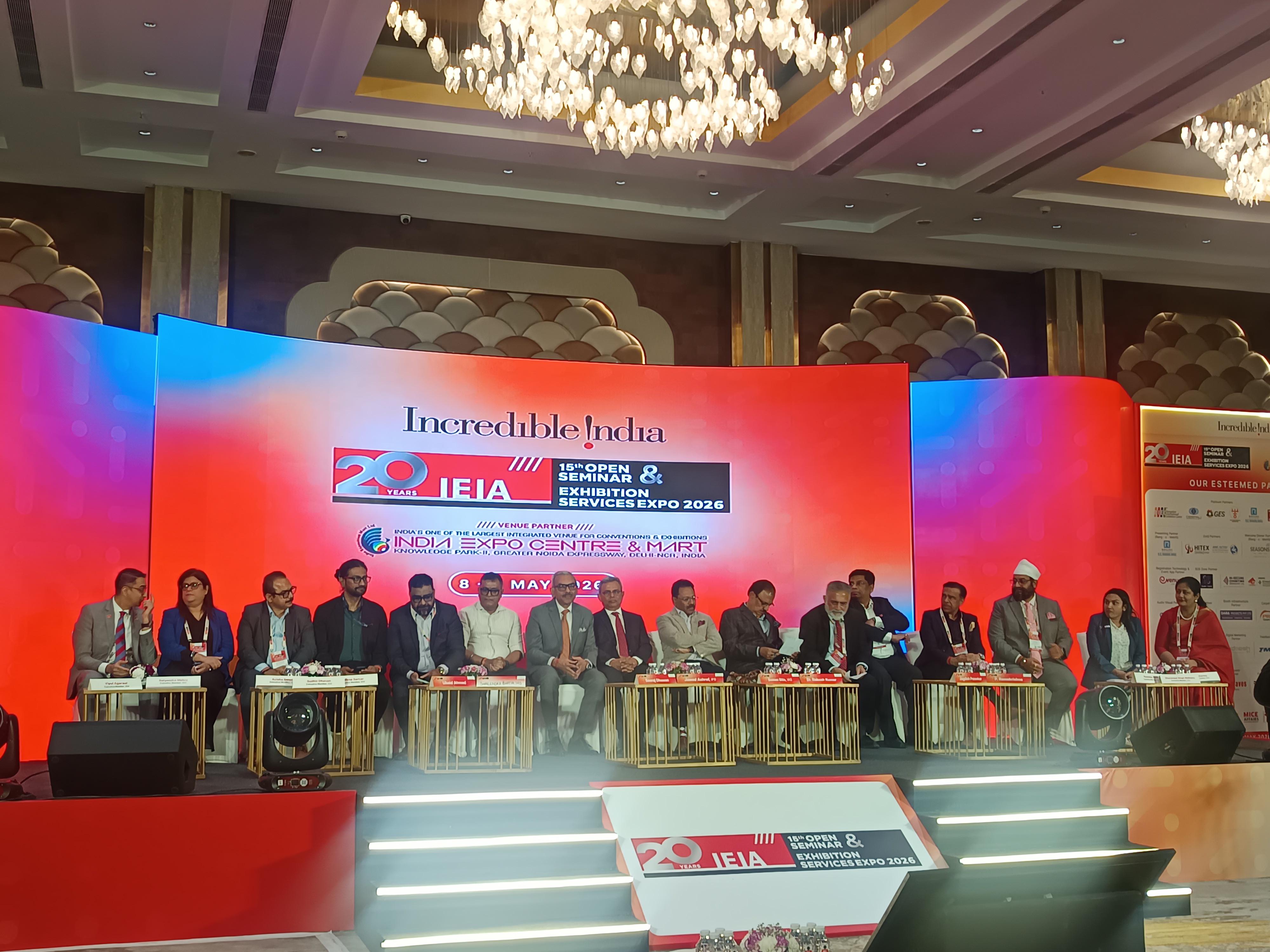 Representative Image_IEIA Open Seminar 2026
Industry leaders also estimated that the sector’s wider multiplier effect pushes its overall economic impact beyond INR 3 lakh crore. Notably, the 15th IEIA Open Seminar 2026 was held in Greater Noida from May 8-9, under the theme ‘When the Right Dots Meet, Industry Moves.’
India’s MICE industry, notably the exhibition sector, is entering a transformative phase. No longer confined to being just a hospitality-driven business vertical, the sector is increasingly emerging as a strategic economic and diplomatic tool capable of driving trade, investments and global engagement.
Backed by expanding infrastructure, stronger government focus and rising international interest, India is positioning itself as a serious contender in the global exhibitions landscape. According to an industry report estimates, India’s MICE tourism market, valued at USD 37.75 billion in 2025, is projected to grow to USD 74.12 billion by 2031, registering a CAGR of nearly 12%. A part of this, the exhibition industry in India is a crucial economic driver too, valued at approximately INR 55,000 crore, and expected to grow approximately USD 4.4 billion by 2028. However, there’s room for improvements.
This larger ambition and the roadblocks ahead formed the core of discussions at the 15th IEIA Open Seminar 2026 held in Greater Noida under the theme “When the Right Dots Meet, Industry Moves.” The event brought together over 1,200 stakeholders including exhibition organisers, venue owners, global delegates, policymakers, trade bodies and service providers.
The edition served as a powerful platform for collaboration, innovation, knowledge exchange, strategic networking, and business acceleration, reaffirming India’s emergence as a global exhibitions and MICE powerhouse. Besides, the strategic importance of exhibitions in driving trade, tourism, manufacturing, investments, and international business engagement was widely discussed.
Collaboration is the key
Amid growing geopolitical uncertainties and shifting global trade dynamics, Jawed Ashraf, IAS, Chairman of the India Trade Promotion Organisation (ITPO), highlighted how exhibitions are increasingly becoming strategic platforms for trade diplomacy and international business expansion.
He added that SMEs participating in trade fairs have a significantly higher probability of securing business deals compared to conventional outreach methods. However, Ashraf stressed that for India to emerge as a true global exhibition hub, the domestic ecosystem must move beyond fragmentation and become globally competitive against mature exhibition markets such as Germany and China.
“Our role as government is to act as force multipliers for the industry. We must work together in an integrated manner to create a seamless participant experience from arrival to departure and continue strengthening the ecosystem through collaborative PPP-led approaches with the industry,” he said.
Echoing the need for strategic execution, Suman Billa, Additional Secretary and Director General, Ministry of Tourism, said India’s growth ambitions in tourism and MICE would require deliberate planning rather than organic expansion. “Growth will not happen as a matter of accident. Growth should happen as a matter of design,” he remarked.
He linked the growth of the exhibition industry to Prime Minister Narendra Modi’s broader vision of doubling tourism’s contribution to India’s GDP from the current 5% to the global average of 10% over the next decade.
Billa also highlighted the rapid expansion of India’s connectivity ecosystem, noting that the number of airports has doubled from 75 in 2014 to 150 today, while expressway development has accelerated dramatically. India’s commercial aviation fleet is also expected to double from 1,000 to 2,000 aircraft in the coming years.
Yet, he argued that infrastructure alone cannot deliver global competitiveness. Instead, India needs coordinated destination-level strategies where local governments, hotels, venues and transport stakeholders jointly bid for international conventions and exhibitions through dedicated city bureaus.
Also speaking during the event, Shailendra Kumar Bhatia, Additional CEO of Yamuna Expressway Industrial Development Authority, underlined the sector’s growing economic significance, stating that while the core exhibition business is currently valued at nearly INR 50,000 crore, its wider multiplier effect pushes the overall economic impact beyond INR 3 lakh crore.
On the sidelines of the seminar, Dr. Rakesh Kumar, Chairman of India Expo Centre and Mart (IEML), also outlined the event venue’s long-term ambitions to position Greater Noida as a major international exhibitions’ hub.
Operating as a Public-Private Partnership (PPP) model with participation from over 1,250 SME exporters, IEML expects the upcoming Noida International Airport to significantly improve global accessibility and reduce logistics costs for exhibitors. With sustainable infrastructure and growing connectivity, the venue is targeting nearly one million annual MICE visitors by 2030 as India’s exhibition economy continues its rapid expansion.
Expansion beyond Metros & the growing skill crisis
IEIA President Sooraj Dhawan pointed out that geopolitical instability across several regions is also creating opportunities for India to position itself as a safer and more stable destination for global events.
“Several international shows have either been postponed or rescheduled globally, and India is increasingly being viewed as a safe alternative destination,” Dhawan said.
He added that the next phase of exhibition growth would increasingly move beyond saturated metro markets into Tier 2 and 3 cities such as Varanasi, Goa, Bhubaneswar and Kerala, where state tourism boards are actively looking to strengthen event infrastructure and tourism economies.
However, Dhawan cautioned that the sector’s biggest challenge today is not venue capacity, but the shortage of skilled manpower and service capabilities required to support rapid expansion.
“The challenge today is not about venues or organisers. The real challenge lies in the service ecosystem and the shortage of skilled professionals,” he said.
To address this gap, IEIA has begun investing heavily in skill development through its Professional Exhibition Management programme, while also encouraging the industry to build a more AI-enabled workforce capable of improving efficiency and operational quality, Dhawan confirmed.
IEIA Seminar over two days
The conclave opened with pre-event engagement through IEIA’s high-level sub-committee meetings, covering themes such as sustainability, AI and digitalisation, logistics, venues, women in leadership, skilling, ethics, sports and wellness, and MICE hospitality.
Apart from closed door discussions, the delegates participated in fireside chats, panel discussions, strategic networking forums, and the exclusive CEOs Roundtable chaired by Suman Billa IAS and also explored several human-centric and operational themes shaping the future of exhibitions and events. The sessions and discussions focused on topics including B2B marketing, workplace culture, AI and digitalisation, sustainability, visitor engagement, MarTech, event experiences, and future trade show strategies.
Beyond formal sessions, the event integrated curated networking and entertainment experiences, fostering camaraderie and relationship-building. Notably, the association also completed and celebrated its 20 years of its inception and industry leadership.
“It is wonderful to see the exhibition industry come together once again for meaningful conversations and collective growth. The exchange of ideas, innovation, and collaboration at such gatherings continues to inspire new opportunities and strengthen industry connections,” stated Jagdish Patankar, Hon. Secretary, IEIA.
“India has immense potential, and the next 10 years will be about India and only India. Across sectors, the country is witnessing remarkable growth, stronger global positioning, and expanding opportunities, with the exhibitions and MICE industry playing a significant role in this journey,” shared Ubaid Ahmad, Vice President, IEIA, concluding the event proceedings.
(Collated by Kartika Kiran)