

Age of turbulences in the aviation sky
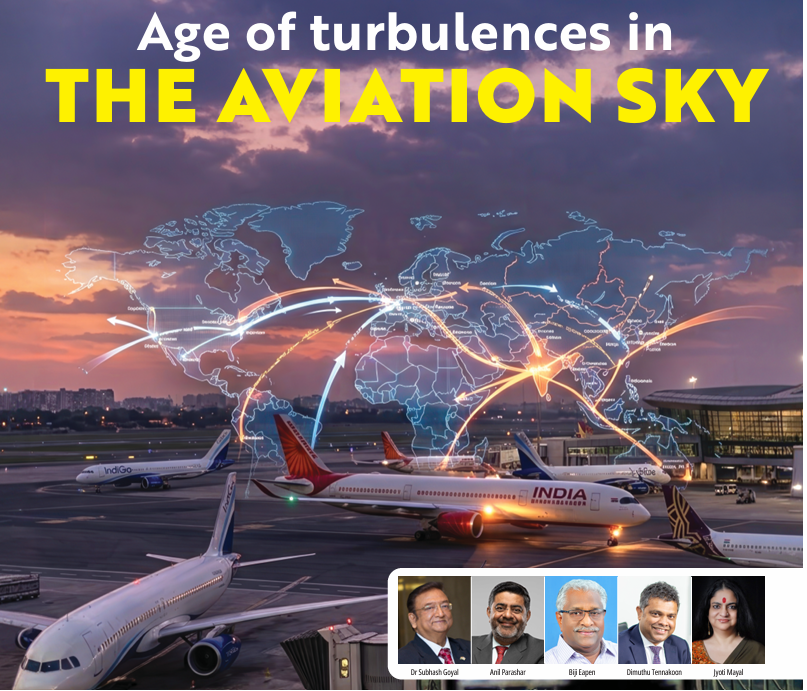 Cover Image -1
Geopolitical shifts redrawing global air routes, rising costs and supply chain disruptions are testing the resilience of airlines worldwide. And in the middle of this, India's aviation story continues to soar, the industry is increasingly being forced to rethink growth, profitability and preparedness in an era where uncertainty has become the new normal.
For an industry that had only recently emerged from the unprecedented disruption of the pandemic, aviation industry once again finds itself navigating turbulent skies. Just as airlines across the world were rebuilding networks, restoring profitability and committing to ambitious expansion plans, a fresh wave of geopolitical conflicts has altered the operating landscape yet again.
Beginning with Russia - Ukraine war, followed by escalating tensions across the Middle East, trade disputes, aircraft delivery delays and volatile fuel prices have collectively transformed what was expected to be a period of sustained recovery into one defined by constant recalibration. Most recently, the US-Iran conflict and its impact on global aviation have forced a reality that airlines can’t really ignore.
What begins as an airspace closure or fuel price spike quickly ripples through airports, travel businesses, hospitality providers and entire tourism economies.
This cover story evaluates India’s aviation growth trajectory, how the industry continues to remain intact despite mounting global uncertainties, and more importantly, if airlines prepared to brace for the impact.
Bracing for impact
Recent developments showcase how rapidly geopolitical events can reshape airline strategies. Air India previously had reduced nearly 15% of its domestic operations while trimming capacity on select European and North American routes. IndiGo also suspended services to several destinations across West Asia and beyond, underlining how swiftly network planning can be influenced by geopolitical developments.
The timing is particularly significant.
While passenger demand continues to demonstrate remarkable resilience, profitability is coming under increasing pressure. According to IATA, airline revenues are expected to continue growing in 2026, supported by stronger yields and higher fares. Yet the industry's net profit is projected to decline sharply to USD 23 billion, almost half the level recorded in 2025, while net margins are forecast to fall to 2%, marking the weakest performance since aviation's post-pandemic recovery.
Higher fuel prices, airspace restrictions and longer routings are expected to moderate global passenger traffic growth to 2.1% in 2026, a notable slowdown compared to recent years.
For airlines, the challenge is not simply recovering demand; it is sustaining profitable growth while operating in an unpredictable environment.
Dimuthu Tennakoon, Head of Commercial at SriLankan Airlines, believes these developments have fundamentally altered how airlines approach expansion. "Recent global developments, including geopolitical uncertainty, aircraft delivery delays, fuel price volatility and shifting travel demand have prompted the airline to adopt a more flexible and resilient growth strategy," he said.
Rather than relying on traditional long-term planning cycles, Tennakoon explained that network decisions have become increasingly demand-driven, enabling airlines to respond swiftly to changing market conditions by optimising routes, prioritising profitable markets, and strengthening connectivity in destinations with strong long-term growth potential.
“Fleet deployment has also evolved into a far more strategic exercise,” he shared, adding, “with greater emphasis on maximising aircraft productivity and deploying capacity efficiently amid ongoing supply constraints, particularly due to delays in replacing lease-expiring aircraft."
Yet despite prevailing uncertainties, India continues to feature prominently in the airline's long-term plans. SriLankan Airlines remains committed to expanding its Indian network, with Ahmedabad set to become its 10th destination in India during Winter 2026, a move that reflects confidence in India's sustained travel demand despite global volatility.
How the skies are changing
If there is one theme that now consistently lingers across the aviation industry, it is this: growth alone is no longer enough. Resilience has become equally important.
Dr. Subhash Goyal, Chairman of STIC Travel & Air Charter Group and Chairman of the Aviation and Tourism Expert Committee at the Indian Chamber of Commerce (ICC), believes that while the industry's operating environment has undoubtedly become more complex. "India is one of the world's fastest-growing aviation markets," he said, pointing out that the country today has around 160 operational airports, including 36 international airports.

He attributed much of the post-pandemic demand surge to changing consumer behaviour. “The industry's confidence in India's future is best reflected in unprecedented aircraft orders. Air India has committed to 570 aircraft, including 470 ordered in 2023 and an additional 100 Airbus aircraft in 2024, while IndiGo has placed a record order for 500 Airbus aircraft,” he said.
According to Goyal, these investments underline that temporary geopolitical shocks may slow expansion but are unlikely to change the approach of the carriers towards route development, fleet deployment and long term growth strategies.
Instead, airlines are becoming increasingly measured in how they deploy capacity. "Rather than rushing to launch new international routes, airlines are focusing on destinations where demand is stable and operations can be adjusted quickly if circumstances change," he explained. Many airlines are also using newer, more fuel-efficient aircraft to reduce operating costs. Despite these challenges, the future of aviation in India remains very promising.
Echoing similar views, Biji Eapen, President of the Airline Users Rights and Grievance Redressal Forum (AURGRF) and the IATA Agents Association of India (IAAI), believes geopolitical conflicts, fuel-price volatility, workforce shortages and supply chain disruptions have shifted aviation away from growth-centric models towards resilience-centric strategies.
"Route development decisions are becoming more dynamic, with carriers prioritising network flexibility, diversified market exposure and the ability to rapidly redeploy capacity when disruptions occur," he said. Fleet planning, he added, is also evolving, with greater emphasis on fuel-efficient aircraft capable of operating longer routings and adapting to changing market conditions.
Yet, despite these evolving operational priorities, India's aviation outlook continues to inspire confidence. "As the world's third-largest domestic aviation market, supported by expanding infrastructure and UDAN's network of 157 airports, demand is expected to remain robust," said Eapen.

However, he cautioned that rapid expansion must be accompanied by organisational preparedness. "The large-scale scheduling disruptions and pilot shortages witnessed in late 2025 demonstrated the risks of capacity expansion outpacing organisational capability."
Future growth, therefore, will depend not merely on adding aircraft or routes, but equally on strengthening safety management, regulatory effectiveness, operational resilience and passenger trust.
Anil Parashar, Executive Director at ITQ Technologies, observes that aviation is undergoing a strategic shift from efficiency-led growth to resilience-led planning. "The focus is no longer solely on expanding capacity but on building the ability to redeploy assets, recalibrate schedules and respond swiftly to evolving market dynamics," he said.
In today's environment, where uncertainty can emerge with little warning, he believes agility has become aviation's greatest competitive advantage.
India, however, continues to stand apart. Supported by expanding airport infrastructure and a growing middle-income population, passenger traffic is projected to rise from around 412 million in FY25 to approximately 665 million by FY31.
"Short-term disruptions may affect specific markets, but they are unlikely to alter India's broader aviation trajectory," Parashar said, adding that future expansion will increasingly be disciplined, technology-enabled and operationally resilient.
Jyoti Mayal, Chairperson of the Tourism and Hospitality Skill Council (THSC), shared a similar perspective. "The current situation is a reminder that aviation operates in an increasingly interconnected world where developments thousands of miles away can influence decisions almost instantly," she said.
According to Mayal, airlines are responding by embedding greater flexibility into route planning, evaluating alternate corridors, diversifying market exposure and deploying aircraft more dynamically in response to evolving geopolitical and commercial realities.
She also pointed to the growing importance of investments in fuel-efficient aircraft, digital planning tools and strategic partnerships as airlines balance expansion with operational resilience.
Despite current headwinds, she remains optimistic about India's long-term prospects. India's strong economic growth, rising travel aspirations and expanding infrastructure continue to underpin demand. The country's airport network has expanded from just 74 airports in 2014 to more than 160 today, while passenger traffic surpassed 411 million during FY25. "Short-term disruptions may influence the pace of growth, but the broader direction remains firmly positive," she explained.
The invisible cost of disruptions?
For travellers, the immediate impact of aviation disruption is usually visible in delayed departures, longer flight times or higher fares. For the industry, the consequences run much deeper.
According to Eapen, the less visible impacts include declining passenger confidence, disruption to tourism and business travel, higher logistics costs, supply-chain delays, financial stress on airlines, airports and travel agents, and reduced investor confidence.
Operationally, sustained disruptions increase crew fatigue, rostering complexity, maintenance backlogs, training gaps, supply-chain constraints, and workload pressures, placing greater demands on airline Safety Management Systems (SMS) and regulatory oversight. If not effectively managed, these pressures gradually erode safety margins, operational efficiency, and service reliability, according to Eapen. Equally important, he said, is greater public awareness around aviation safety.
"The industry's resilience will ultimately depend on preventing disruptions through proactive risk management rather than merely recovering from them,” he emphasised.
Economic resilience, he added, deserves equal attention. Capacity constraints and market concentration can lead to excessive fare escalation during disruptions. In this context, Eapen believes the proposed ATF Price Stabilisation Fund could play an important role in promoting transparent pricing while curbing price volatility, cartelisation, and monopolistic practices.
Ultimately, he shared, India's aviation growth can only be sustained, if safety remains paramount. True resilience lies in anticipating risks, ensuring safe and reliable operations, fostering healthy competition, strengthening passenger confidence, protecting consumer interests, and delivering a safe, reliable, and passenger-centric aviation system.
Goyal believes one of the least discussed consequences could be the impact on inbound tourism. "The invisible consequence of prolonged aviation disruption is the decline in inbound tourism into the country," he said, adding that Indian exports transported by air also become more expensive as airlines incur higher operating costs.
Moreover, the impact of aviation disruptions goes far beyond the airlines themselves. According to Goyal, some long-haul flights are now taking between 10-20% longer than before, increasing expenditure on fuel, crew and operations while also extending journey times for passengers.
Even so, he remains confident that the industry is considerably better equipped to navigate these challenges than it was a decade ago. "Airlines have better planning systems, advanced route planning technology and greater experience in managing disruptions,” he said.

For Parashar, resilience has become the defining characteristic of the next phase of aviation development. While India's passenger traffic is projected to increase from approximately 412 million in FY25 to 665 million by FY31, he believes future growth will depend as much on navigating uncertainty and building resistance as on expanding capacity.
"These disruptions extend far beyond delayed or cancelled flights," he added, “with effects that ripple across the entire travel ecosystem - from tourism and trade to airline operations and cargo movement."
Airlines are having to navigate longer routings, higher operating costs and more complex network planning, while travellers are becoming increasingly conscious of reliability and predictability when making travel decisions.
Parashar also credits the Indian government's intervention during periods of volatility. “Measures such as absorbing a significant share of increased domestic operating costs, temporary reductions in airport landing and parking charges, the introduction of a INR 10,000 crore fuel stabilisation fund and state-led reductions in VAT on aviation fuel have helped ease pressure on the industry and maintain momentum,” he explained.
Combined with the strength of India’s demand fundamentals, policy support and continued investment across the aviation ecosystem, Parashar remains confident that India’s long-term aviation growth story is firmly on track.
Mayal also believes the effects of aviation disruption often become visible far away from airports. Reduced air connectivity influences tourist arrivals, hotel occupancy, business events, local employment, supply chains and investor sentiment. Emerging destinations are particularly sensitive because air access often acts as the catalyst for tourism growth and economic activity. "When connectivity weakens, the entire local ecosystem feels the impact," she noted.

At the same time, Mayal believes the aviation and tourism sectors have emerged from the pandemic with stronger crisis management capabilities. Communication systems are stronger. Digital capabilities have improved significantly. Coordination between stakeholders is far more structured. India has also continued to invest aggressively in aviation infrastructure.
She also pointed to India's sustained investment in airport infrastructure, including plans to add another 100 airports under the revamped UDAN scheme and the long-term vision of expanding the country's airport network to between 350 and 400 airports by 2047.
While aircraft availability constraints and geopolitical developments may moderate growth during FY26, Mayal said forecasts continue to indicate healthy passenger traffic growth over the coming years.
"Aviation growth rarely follows a straight line," she remarked. “The real test lies in how effectively the ecosystem adapts.”
What it means for tourism
Even as airlines work to absorb rising costs through operational efficiencies, there is broad consensus that sustained increases in fuel prices, global shocks, and longer routings cannot be managed indefinitely without affecting fares. For travellers, that eventually translates into more expensive journeys.
According to Eapen, airlines can absorb a portion of rising costs through operational efficiencies, fuel management strategies, improved aircraft utilisation, and network optimisation. However, prolonged increases in operating expenses inevitably find their way into ticket prices.
He noted that recent volatility in crude oil prices highlighted this challenge. Airfares rose rapidly when crude crossed USD 120 per barrel during the Middle East tensions, yet passengers have seen little corresponding reduction as prices retreated. Such perceptions, he warned, can weaken consumer confidence, especially discretionary and price-sensitive travellers, particularly in emerging markets like India.
He added, “Airlines must therefore balance commercial sustainability with fair pricing and a consistently reliable passenger experience.”
Goyal shared a similar assessment, arguing that airlines simply cannot absorb prolonged increases in fuel costs, saying, “They will pass it on the passengers and therefore that is the reason air fares have sky rocketed.”
He pointed out that economy excursion fares to North America, which averaged around INR 60,000 before the pandemic, now range between INR 1.5 - 2 lakhs, while business class fares have climbed to between INR 4 - 5 lakhs. Airfares to Europe and all over the world have also gone up by about 100%.
With ATF accounting for nearly half of airlines' direct operating costs, he said airlines can absorb only a small part of the increase in fuel and operating costs because their profit margins are already very low.
He further explained, “To recover these increased costs, airlines raise airfares, making air travel more expensive for passengers. Even a 10-15% rise in ticket prices can influence people to postpone their trips, choose closer destinations or cancel their travel plans.”
Parashar believes airlines have demonstrated considerable resilience by absorbing a significant proportion of rising costs. Nevertheless, he cautioned that there is a limit to how long this can continue without affecting broader market behaviour, indicating that fuel expenditure could rise from approximately USD 252 billion in 2025 to nearly USD 350 billion in 2026.
Although global airline revenues are expected to continue growing by around 9 - 10% in 2026, supported by healthy passenger demand and average load factors of around 84%, reflecting the sector’s ability to adapt under challenging conditions.
"Historically, fare increases beyond the 10 - 15% range tend to affect travel frequency and destination choices. In India, demand fundamentals remain robust, but extended periods of elevated costs could gradually soften discretionary travel demand over time," he explained.
Mayal agrees that while airlines have become increasingly efficient in managing costs through better fleet utilisation, ancillary revenues and improved yield management, the scale of current challenges leaves limited room for further absorption.
"The first impact is usually seen in leisure travel," she said. Travellers become more selective about destinations, duration of stay and booking windows, while some choose destinations closer to home or well in advance in pursuit of better value.
Yet she believes, "Travel today has become an integral part of people's aspirations, business activities, personal aspirations, family experiences, and lifestyle spending," Mayal said. “Demand is becoming more value-conscious, but the desire to travel remains remarkably strong.”
The airline’s response
For SriLankan Airlines, the current fuel price environment has significantly increased operating costs, echoing the concerns raised by IATA that airlines cannot indefinitely absorb rising fuel expenses without affecting their financial performance.

According to Tennakoon, the carrier has adopted a measured approach towards cost recovery. "While fares have been adjusted selectively to recover part of the increased costs, our focus remains on balancing cost recovery with sustaining demand through disciplined capacity management, network optimisation, improved fleet utilisation and the expansion of ancillary revenues, rather than relying solely on fare increases," he explained.
However, geopolitical developments have affected markets differently. For SriLankan Airlines, the Middle East - one of its key regions for both point-to-point and transit traffic, experienced a noticeable decline in demand following recent geopolitical developments.
Encouragingly, demand across the region is gradually stabilising. Nevertheless, Tennakoon observed that several other markets continue to recover at a slower pace than they did prior to the geopolitical unrest.
These changing market dynamics, he said, reinforce the importance of maintaining a flexible, demand-led commercial strategy that enables airlines to respond swiftly to evolving conditions while safeguarding long-term profitability.
A growth story still intact
Looking beyond the current challenges, Tennakoon believes the aviation industry has repeatedly demonstrated its ability to adapt to adversity. From navigating the pandemic to managing aircraft delivery delays, fuel price volatility and persistent geopolitical uncertainty, airlines have continually evolved.
According to Tennakoon, despite rising operating costs resulting from airspace restrictions, longer flight routings and increased fuel consumption, carriers have responded by adopting more flexible network planning, disciplined capacity management and greater operational efficiency.
He remains optimistic about India's long-term aviation prospects, noting that the country's strong economic growth, expanding middle class, continued airport infrastructure development and growing appetite for both domestic and international travel continue to provide a solid foundation for future expansion.
While geopolitical developments may temporarily influence travel demand and delay certain airline expansion plans, Tennakoon believes they are unlikely to derail India's broader aviation growth story.
"Airlines that remain flexible and responsive to changing market conditions will be best positioned to navigate these uncertainties while capitalising on India's significant long-term aviation potential," he concluded.